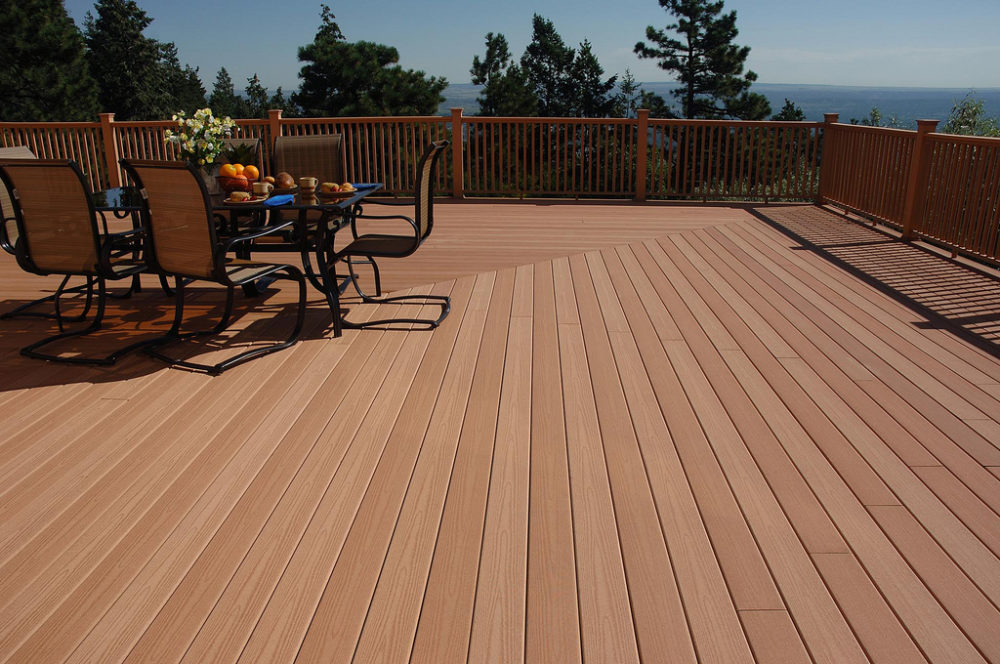
Okay, after a 45-minute conversation with the customer service rep at ChoiceDek's manufacturing plant (and 6 full pages of notes!), I have to say I am quite impressed by what I've learned so far.
Both, about composite decks in general, and the ChoiceDek brand (also sold as MoistureShield), specifically.
Where do I begin???
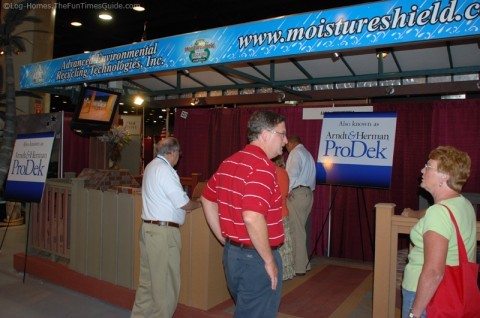
Advanced Environmental Recycling Technologies
First, to clarify... ChoiceDek is sold exclusively by Lowe's.MoistureShield is the exact same product made by the exact same manufacturer, just with different "embossing" patterns to give it that wood look and a couple of different colors as well. MoistureShield is sold through individual distributors throughout the country.
Both ChoiceDek and MoistureShield are made by Advanced Environmental Recycling Technologies (AERT), based out of Arkansas.

Read about AERT's interesting history.
How "Low Maintenance" Is ChoiceDek?
The very first question I asked the guy at the manufacturing plant was: "I've heard composite decks are low-maintenance, blah, blah, blah. But there must be some maintenance required. Right?"The answer is, yes. You won't ever have to treat, seal, sand, or stain a composite deck. And you won't get splinters. But you do need to clean it!
They recommend cleaning it twice a year, primarily to remove any build-up of dirt and leaves that might accumulate over time.
To clean it (and at the same time remove & prevent even the smallest traces of mold & mildew) simply mix a homemade solution of "outdoor" bleach, water, and dishwashing liquid. Use a garden sprayer to apply it. Leave it on for 30 minutes. Then rinse it off with a garden hose. There is no brushing required at all.
After each cleaning, you should apply a solution called Olympic Deck Brightener. It has oxalic acid in it which helps to maintain the color of your deck and prolong its life overall. (UPDATE: I spoke with another rep for the company who said you really only need to apply this product once... when you first install your deck for the reason mentioned below...)
The Olympic Deck Brightener is good because those places where metal touches the deck (including at the fasteners/screws), "tannin stains" will inevitably result, unless you use the Brightener product which prevents that type of staining by neutralizing the area (or technically... the wood fibers inside the composite).
The rep from AERT also told me, "As far as I know, nobody is putting a warranty on mold & mildew because it's an environmental condition that is beyond any manufacturer's control."
Supposedly, the mold -- if it appeared at all -- would only appear on the surface of the composite decking material. And it can be treated on the surface, without influencing the life of your deck.
I asked if the planks of composite decking were "rough" on the bottom and "finished" on the top. The ChoiceDek rep said, "No. It's identical all throughout the entire piece."
UPDATE: I think he misunderstood me. I realize the composite material itself is the same from the top all the way through the bottom of the plank -- therefore, there is no color difference in the "core" or anything like that. But I have since learned that the "embossing" that gives composites that woodgrain look does not run through the entire plank -- it's merely "stamped" (technically, it's "rolled on") on top. In fact, the embossing that gives composites their woodgrain look even wears down ever so slightly over time. Not enough to ever need re-stamped or anything though. And more on the stairs than on the deck itself.
What About Fading Over Time?
I asked the rep from AERT if the bleach used in the cleaning process caused the decking to fade at all?He said, yes slightly. But the fact of the matter is most composites will fade anyway over time. You will see the most noticeable change in color during the first 6 months after you first install your deck -- bleach or no bleach.
The color change process pretty much tops out at the 6 month time period. So whether it fades from sunlight, bleach, or whatever... it would fade to the same degree. Period.
As an example of the fading, he said the Sandstone color of ChoiceDek turns to a chalky, milky white over time.
Eeek! I stepped on the brakes right there and asked him how I could see examples of the ChoiceDek product over time... rather than brand new.
He said he could send me brand new samples of every color available, along with a brochure that showed how those colors fade over time -- a before & after for each color. But he didn't have any weathered samples. (At least the brochure's before & after photos should help a bit.)
When I told him that Lowe's wouldn't give me any samples of the ChoiceDek product (new), he wasn't surprised at all. Instead, he recommended that I contact a local distributor for MoistureShield. He said they would more than likely be happy to give us some "new" samples, as well as some "weathered" samples.
Since they sell the product for a living, they tend to have actual samples and are more willing to provide them to potential customers. That way, we would be able to touch & feel (and compare side-by-side) various decking materials.
What About Those ChoiceDek Channels On The Bottom?
According to the AERT rep, those channels have 3 purposes:1) They eliminate weight, while still maintaining the integrity and strength of the board.
2) They help ventilate the deck.
3) They help the planks lie flatter.
Comparing Composite Deck Manufacturers
Finally, when I asked him how ChoiceDek compared to other composite decking materials, say TimberTech, for example (because that's the next easiest one for me to research and get samples from locally), he said:"I'm not up-to-date on all the changes going on with all the other composite decking manufacturers. So I really can't compare apples-to-apples. I can tell you that many of the things we've already talked about, and many of the great questions you've already asked, touch on many of ChoiceDek and MoistureShield's strengths. For example, the channels on the bottom of the deck planks."
He also reminded me that AERT is one of the original composite decking manufacturers, having started their business in 1989.
Installation Tip For Composite Decking
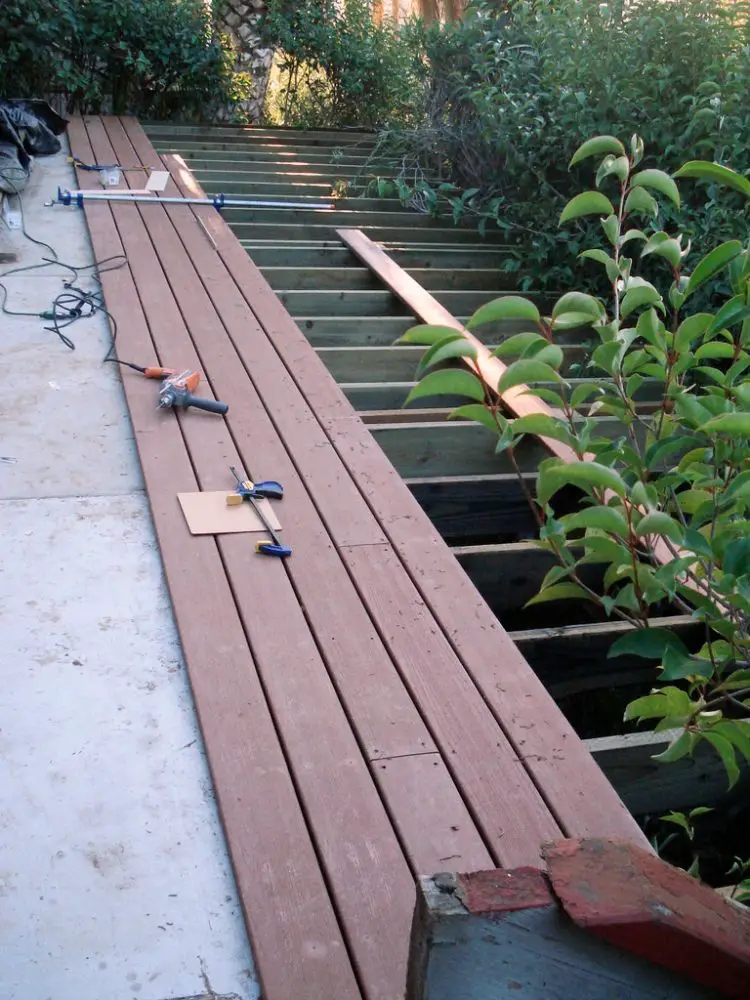
Before we said goodbye, he reminded me of one very important thing, no matter which composite decking company you go with:Follow the installation directions to a tee because there is a big difference in composite deck planks vs pressure-treated wood planks that many DIY'ers (and contractors) are more familiar with.
That difference is... Composite decking swells over time. Whereas pressure-treated wood shrinks over time.
For that reason, you need to space them accordingly (according to the instructions) when you are installing your deck. If you don't allow adequate spacing during the installation phase, then you'll be paying the price later. And it may void your warranty. Good to know.
How Much Does ChoiceDek Cost?
The AERT rep said the individual stores set their own prices, so pricing for ChoiceDek varies from store to store, as well as from region to region.The best thing to do is to visit a Lowe's store and stop by the Contractors Sales Desk. They have designs on hand for you to pick & choose from. Or you can give them blueprints for exactly what you want. They will give you an estimate, as well as a list of installers they recommend. Which could be helpful, since composite decking is so different from regular pressure-treated decking.
UPDATE: I have since learned that $5 per square foot is a good ballpark figure for ChoiceDek/MoistureShield.
I have to say, I asked this guy so many "loaded" questions it wasn't funny. But he was incredibly helpful, honest, and understanding. I have great respect for him and AERT. First impressions go a long way.
8 Comments
Leave a comment
- Debt Support Groups Help You Get Out Of Debt Faster
- Are Cigarette Butts Poisonous To Dogs?
- How To Clean A Fly Rod
- Your Interior Design is Killer...No, Literally
- Is Your RV's Monitor Panel Always Showing A Full Black Water Tank?
- How To Pay Off Old Bills While Raising Your Credit Score Using The 'Pay For Delete' Method
- Why Homemade All Natural Dog Food Is Better Than Store-Bought Natural Dog Food
- Share Your Own Log Home Stories Here...
- 6 Easy Tips to Help Your Dog Live Green
- Fun With Halloween Rubber Stamps


Choicedek is terrible- the mold is pervasive, it just keeps coming bak no matter what i do. I spend more time caring and feeding this stupid deck!
Investing in this product is a decison that have come to deeply regret !
I understand that a class action lawsuit is possible?
http://www.lieffcabraser.com/choicedek.htm
So is anyone happy with their Choicedek?
I have choicedek and the only problem I have had with it is that any area that has been covered discolored and I can't get the color to return to it's original color of gray in the covered spots it has turned to a light brown color.
Simpson Strong-Ties (manufacturers approx. 77% of all decking hardware) clearly discloses the "General Corrosion Risks" of "chemicals" like using chlorine bleach and products containing sodium hypochlorite/calcium hypochlorite to clean composites.
www.strongtie.com/productuse/corrosion_risks.html
Use of these chemicals, when used to clean composites will more than likely come into contact with these structural metal connectors causing pre mature failure and related safety issues.
A Note From the U.S. Government About Mold & What NOT To Use In An Attempt To Clean It!
The following is an excerpt from the U.S. E. P. A.
"A Brief Guide to Mold, Moisture, and Your Home":
"Biocides are substances that can destroy living organisms. The use of a biocide or a chemical that kills organisms such as mold (chlorine bleach, for example) is not recommended as a routine practice during mold cleanup. There may be instances, however, when professional judgment indicates their use (for example, when immune-compromised individuals are present). In most cases, it is not possible or desirable to sterilize an area; a background level of mold spores will remain, but these spores will not grow if the moisture problem has been resolved. Never mix chlorine bleach with other cleaning solutions with detergents that contain ammonia because toxic fumes could be produced. (Please note: Dead mold is allergenic and may cause allergic reactions and other health effects in some individuals, so it is not enough to simply kill the mold. It must also be removed."
www.epa.gov/mold/moldcourse/chapter1/lesson7.html
The following is excerpted from O.S.H.A.
"Mold Remediation/Clean Up Methods" guidelines:
"Molds can infiltrate porous substances and grow on or fill in empty spaces or crevices
- Mold can generally be removed from non-porous surfaces by wiping or scrubbing with water and detergent
- Instructions for cleaning surfaces, as listed on product labels, should always be read and followed
- As a general rule, simply killing the mold, for example, with biocide is not enough
- The mold must be removed, since the chemicals and proteins, which can cause a reaction in humans, are present even in dead mold
- The use of a biocide, such as chlorine bleach, is not recommended as a routine practice during mold remediation- In most cases, it is not possible or desirable to sterilize an area, as a background level of mold spores comparable to the level in outside air will persist
- Biocides are toxic to animals and humans, as well as to mold
- Never mix chlorine bleach solution with other cleaning solutions or detergents that contain ammonia because this may produce highly toxic vapors and create a hazard to workers
- When you use biocides as a disinfectant or a pesticide, or as a fungicide, you should use appropriate Personal Protective Equipment (P.P.E.), including respirators "Always read and follow product label precautions. It is a violation of Federal (E.P.A.) law to use a biocide in any manner inconsistent with its label direction." www.osha.gov/dts/shib/shib101003.html.
From "Ability Of Bleach And Other Biocide Treatments To Remove And Prevent Mold On Douglas-fir Lumber," a scientific paper produced by researchers at Oregon State University:
"While bleach is often recommended for remediation of surface mold on wood our results illustrate that the treatment does not eliminate the surface microflora. Molds are an increasingly important issue for all building materials, including wood. While washing with bleach is a commonly recommended method for removing molds and their associated discolorations, there is surprisingly little information on the effectiveness of this treatment. The ability of mold removal treatments to brighten wood and eliminate fungi was assessed on Douglas-fir (Pseudotsuga menziesii) sapwood lumber heavily colonized with mold and sap-stain fungi. The boards were subjected to different washing treatments: wiping with bleach solution, wiping with water, and a no-wash control. Samples were evaluated visually for changes in mold appearance and then fungi were isolated from the surface of the wood. Replicates from the various wash treatments were further treated with three biocide formulations. The effect of the mold control treatments on visual appearance and fungal diversity was assessed 1 month after treatment. Increasing bleach concentrations from 2.5 up to 20 percent solution had no effect on the appearance of the wood following the wash treatment, nor did such treatments completely eliminate fungi from the wood surface. The chemical mold prevention treatments tested were not effective in sterilizing the wood, nor did they improve the visual appearance."
www.traskresearch.com/mold_bleach.pdf
Town & Country Magazine (SPECIAL GREEN ISSUE, April of 2007)
"Chlorine bleach will evaporate within a short period of time, especially when it is used in hot temperatures and the composite surface is in direct sunlight. If the composite is not dry when the bleach evaporates, or moisture is still in the contaminated area on the composite (humidity, outside air dampness, etc.), the contamination process is re-started immediately and to a greater degree." (p.180)
You won't find any information from the American Chemistry Council (A.C.C.) Chlorine Division recommending chlorine be used for cleaning mold but you will find many other legitimate uses. For more information regarding chlorine, please see: www.elmhurst.edu/~chm/onlcourse/chm110/issues/issue397.html
Mr. Smith,
I am sorry to hear you are not happy with your composite deck due to its growing mold. Like any outdoor material exposed to the elements, composite decking is susceptible to mold, especially in geographies with high humidity or other sources of moisture such as morning dew. Rain is not the only source of moisture.
Attempting to clean mold with products like "outdoor bleach" or other biocide (sodium hypochlorite / calcium hypochlorite) containing / mixed with products or deck cleaners is not a good idea for scientific reasons. An example is, biocides are not scientifically proven effective in the mold remediation process on porous surfaces such as composites.
Why do you think the U.S. EPA & OSHA do not recommend chlorine bleach or other biocide containing products for cleaning mold? You may want to do your own homework regarding effectively cleaning mold (mold remediation) and not rely on others beliefs, bogus products and poor recommendations. Your research may shed some light on why the mold returned so quickly.
Let us know if we can be of any further help. We have many satisfied ChoiceDek customers (see testimonials), many who only need to clean their composite once to twice per year (spring & fall).
Choicedek is the worst product ever. Three months after installing mold started to appear. After cleaning with Clorox outdoor bleach mold reappeared after only three weeks. This was during one of the driest summers on record! At this point I'm ready to rip the crap out and go back to wood. I realize no product is maintainance free, but I'm not going to clean my deck every month!!!